Crédits
Interdisciplinary Seminar on Women's Studies at the University of León
aiblag@unileon.es
Digital ISSN: 2444-0221
DOI: 10.18002/cg
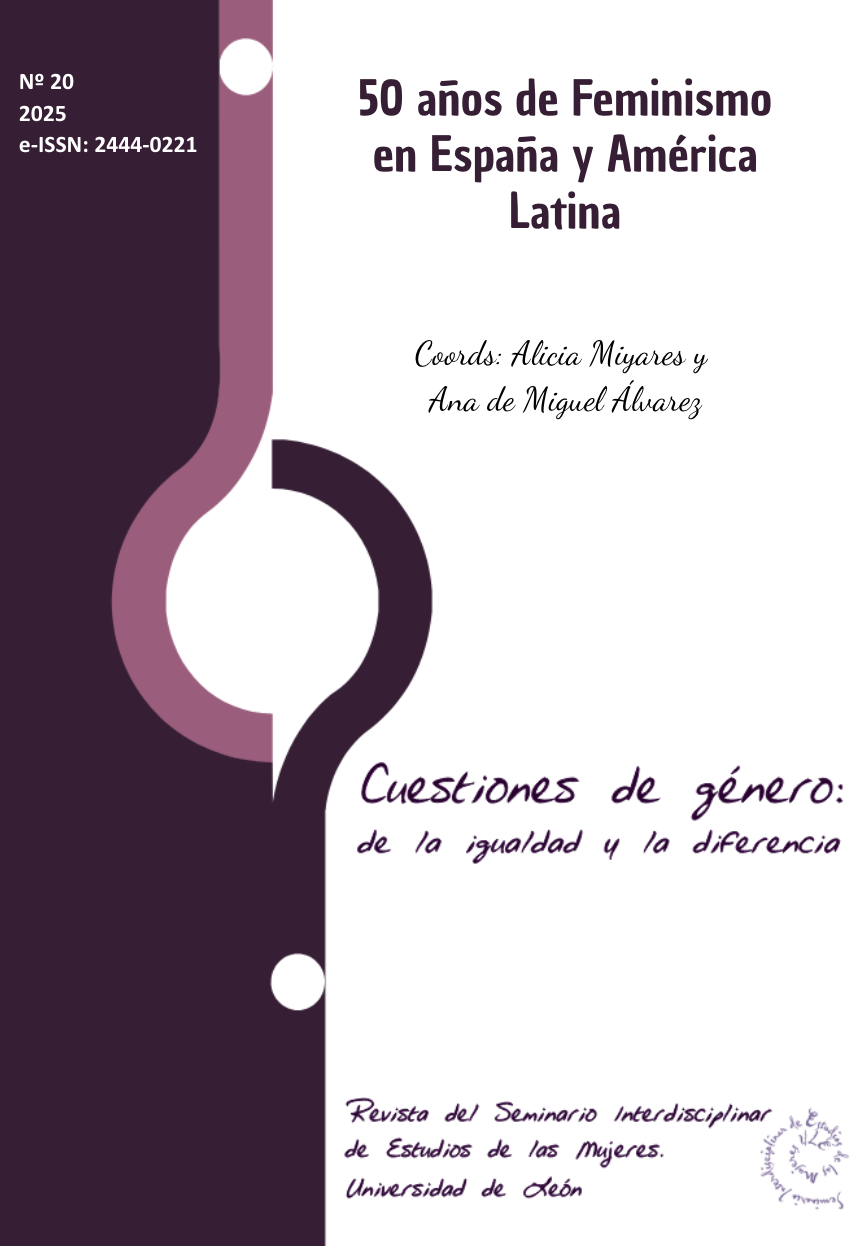
This monograph addresses the profound changes that feminism and the incorporation of women into the public sphere have brought about in our current world. It covers half a century of progress and process, a change that affects the very roots of human self-awareness and social structure. The reasons are not merely chronological: 1975 was a unique year internationally, and in the case of our country, Spain, doubly unique. It was the first International Women's Year decreed by the United Nations and celebrated in Mexico. That same year, 1975, the Spanish dictator who had put an end to hopes for a society committed to equality as the firm foundation for individual freedom died. That society in which Clara Campoamor's arguments succeeded in changing a vote whose outcome was unclear: the one that decided women's right to vote in 1932.
Feminism, which began as a set of demands, today has an agenda steeped in humanism and meaning, strong thought and values, and has ended up constituting a new self-awareness of humanity. The articles in this monograph seek to reflect this path: the effort and courage of conceptualizing a reality with women as human beings and full citizens. They demonstrate the importance of understanding what society has done to women as women, simply because they are women. Feminism rests on making history intelligible in order to create a better future, women and men together, on equal footing.
The issue opens with 15 guest articles by specialists from different areas of knowledge, different generations, and different geographies. It is clear that women are separated by many things, sometimes by an entire ocean, this is a fact: however, feminism, as a philosophy and social movement, detaches itself from the facts to explain and encourage women's struggle to stop being identical, the complement of men, a neutral human being and the measure of what is good and valuable, of the human and social order. Feminism addresses what unites us as women and the obstacles and reactions that fuel, today as yesterday, theoretical confusion—and sometimes erasure and violence—to prevent structural changes and the new Social Contract between women and men, which is already urgent and necessary.
The guest section is structured in three parts that, for formal reasons, cannot be reflected in the Index: 1) Thought and Language, 2) History and Facts, and 3) Debates. Added to this content are nine articles from the monograph, grouped into topics as varied as they are relevant. The issue closes with nine more articles from Tribuna Abierta and eight reviews, along with a profile of Mexican theorist Marcela Lagarde in the "About" section.
Coordinators: Alicia Miyares and Ana de Miguel Álvarez.
Number of articles received: 75.
Number of articles accepted: 18.
Crédits
Interdisciplinary Seminar on Women's Studies at the University of León
aiblag@unileon.es
Digital ISSN: 2444-0221
DOI: 10.18002/cg